Beschreibung
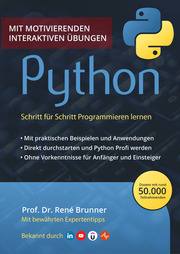
This textbook provides an introduction to the free software Python and its use for statistical data analysis. It covers common statistical tests for continuous, discrete and categorical data, as well as linear regression analysis and topics from survival analysis and Bayesian statistics. Working code and data for Python solutions for each test, together with easy-to-follow Python examples, can be reproduced by the reader and reinforce their immediate understanding of the topic. With recent advances in the Python ecosystem, Python has become a popular language for scientific computing, offering a powerful environment for statistical data analysis and an interesting alternative to R. The book is intended for master and PhD students, mainly from the life and medical sciences, with a basic knowledge of statistics. As it also provides some statistics background, the book can be used by anyone who wants to perform a statistical data analysis.
Autorenporträt
Thomas Haslwanter is a Professor at the Department of Medical Engineering of the University of Applied Sciences Upper Austria in Linz, and lecturer at the ETH Zurich in Switzerland. He also worked as a researcher at the University of Sydney, Australia and the University of Tuebingen, Germany. He has extensive experience in medical research, with a focus on the diagnosis and treatment of vertigo and dizziness and on rehabilitation. After 15 years of extensive use of Matlab, he discovered Python, which he now uses for statistical data analysis, sound and image processing, and for biological simulation applications. He has been teaching in an academic environment for more than 10 years.
Herstellerkennzeichnung:
Springer Verlag GmbH
Tiergartenstr. 17
69121 Heidelberg
DE
E-Mail: juergen.hartmann@springer.com