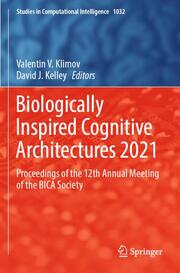
Biologically Inspired Cooperative Computing

Lieferzeit: Lieferbar innerhalb 14 Tagen

106,99 

IFIP 19th World Computer Congress, TC 10: 1st IFIP International Conference on Biologically Inspired Cooperative Computing, August 21-24,2006, Santiago, Chile, IFIP Advances in Information and Communication Technology 216

ISBN: 0387346325
ISBN 13: 9780387346328
Herausgeber: Yi Pan/Franz J Rammig/Hartmut Schmeck et al
Verlag: Springer Verlag GmbH
Umfang: x, 212 S.
Erscheinungsdatum: 01.08.2006
Auflage: 1/2006
Produktform: Gebunden/Hardback
Einband: Gebunden

International Federation for Information Processing The IFIP series publishes state-of-the-art results in the sciences and technologies of information and communication. The scope of the series includes: foundations of computer science; software theory and practice; education; computer applications in technology; communication systems; systems modeling and optimization; information systems; computers and society; computer systems technology; security and protection in information processing systems; artificial intelligence; and human-computer interaction. Proceedings and post-proceedings of referred international conferences in computer science and interdisciplinary fields are featured. These results often precede journal publication and represent the most current research. The principal aim of the IFIP series is to encourage education and the dissemination and exchange of information about all aspects of computing. For more information about the 300 other books in the IFIP series, please visit www.springer.com. For more information about IFIP, please visit www.ifip.org.

Artikelnummer: 4992685 Kategorie:

Beschreibung

In the world of information technology, it is no longer the computer in the classical sense where the majority of IT applications is executed; computing is everywhere. More than 20 billion processors have already been fabricated and the majority of them can be assumed to still be operational. At the same time, virtually every PC worldwide is connected via the Internet. This combination of traditional and embedded computing creates an artifact of a complexity, heterogeneity, and volatility unmanageable by classical means. Each of our technical artifacts with a built-in processor can be seen as a ''Thing that Thinks", a term introduced by MIT's Thinglab. It can be expected that in the near future these billions of Things that Think will become an ''Internet of Things", a term originating from ETH Zurich. This means that we will be constantly surrounded by a virtual "organism" of Things that Think. This organism needs novel, adequate design, evolution, and management means which is also one of the core challenges addressed by the recent German priority research program on Organic Computing.

Herstellerkennzeichnung:


Springer Verlag GmbH
Tiergartenstr. 17
69121 Heidelberg
DE

E-Mail: juergen.hartmann@springer.com

Das könnte Ihnen auch gefallen …