Beschreibung
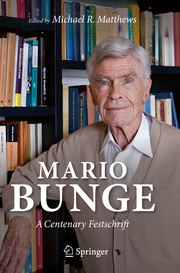
This volume has 41 chapters written to honor the 100th birthday of Mario Bunge. It celebrates the work of this influential Argentine/Canadian physicist and philosopher. Contributions show the value of Bunges science-informed philosophy and his systematic approach to philosophical problems.The chapters explore the exceptionally wide spectrum of Bunges contributions to: metaphysics, methodology and philosophy of science, philosophy of mathematics, philosophy of physics, philosophy of psychology, philosophy of social science, philosophy of biology, philosophy of technology, moral philosophy, social and political philosophy, medical philosophy, and education. The contributors include scholars from 16 countries.Bunge combines ontological realism with epistemological fallibilism. He believes that science provides the best and most warranted knowledge of the natural and social world, and that such knowledge is the only sound basis for moral decision making and social and political reform. Bunge argues for the unity of knowledge. In his eyes, science and philosophy constitute a fruitful and necessary partnership. Readers will discover the wisdom of this approach and will gain insight into the utility of cross-disciplinary scholarship. This anthology will appeal to researchers, students, and teachers in philosophy of science, social science, and liberal education programmes.1. IntroductionSection I. An Academic Vocation (3 chapters)Section II. Philosophy (12 chapters) Section III. Physics and Philosophy of Physics (4 chapters) Section IV. Cognitive Science and Philosophy of Mind (2 chapters) Section V. Sociology and Social Theory (4 chapters) Section VI. Ethics and Political Philosophy (3 chapters)Section VII. Biology and Philosophy of Biology (3 chapters) Section VIII. Mathematics (3 chapters) Section IX. Education (2 chapters) Section X. Varia (3 chapters) Section XI. Bibliography
Autorenporträt
Michael R. Matthews is an honorary associate professor in the School of Education at the University of New South Wales. He has degrees in Science, Psychology, Philosophy, Education and History and Philosophy of Science. He has published articles, books, and edited collections in the areas of philosophy of education, history and philosophy of science, and science education. He was Foundation Editor of the Springer journal Science & Education: Contributions from the History and Philosophy of Science. He has been awarded the Joseph H. Hazen Education Prize of the History of Science Society (USA) in recognition of his contributions to the teaching of history of science. He has been President of the International History, Philosophy and Science Teaching Group, and the Inter-Divisional Teaching Commission of the International Union for History and Philosophy of Science. Contributors Joseph Agassi is Professor of Philosophy Emeritus at Tel Aviv University and York University, Toronto. He is Fellow of the American Association for the Advancement of Science, the Royal Society of Canada, and the World Academy of Art and Science; he is a former Senior Fellow of the Alexander von Humboldt Stiftung. He has published more than 600 papers in diverse fields. He has authored 20 books and edited 10. Evandro Agazzi is Director of the Interdisciplinary Center for Bioethics of the Panamerican University of Mexico City, and Emeritus Professor of the Universities of Genoa (Italy) and Fribourg (Switzerland). He is Honorary President, of the International Academy of Philosophy of Science (Brussel), the International Federation of the Philosophical Societies, the International Institute of Philosophy (Paris). He has published in several languages, as author or editor, more than 80 books and about 1,000 papers and book chapters. His main fields of research are logic, philosophy of mathematics, philosophy of physics, general philosophy of science, ethics of science, metaphysics and bioethics Omar Ahmad is an Internal Medicine physician and Clinical Informatics Lead at Stanton Hospital in Yellowknife, Canada. His main research interests are genetic epidemiology, clinical informatics, and biophysics. Richard T. W. Arthuris Professor of Philosophy at McMaster University, Canada. He researches in early modern natural philosophy and mathematics, the philosophy of physics, and scientific epistemology, specializing in the theory of time, the infinite, and thought experiments. He is author of G. W. Leibniz: The Labyrinth of the Continuum (Yale UP, 2001), Leibniz (Polity, 2014), Natural Deduction (Broadview 2011), Introduction to Logic (Broadview 2017), and over 60 articles and book chapters. Nimrod BarAm is a senior lecturer at the Communication Department of Sapir College, Israel, where he headsa unit for the study of Rhetoric and Philosophy of Communication. He is the author of Extensionalism:The Revolution in Logic (Springer 2008), and In Search of a Simple Introduction to Communication (Springer 2016), as well as numerous papers. Russell Blackford holds a conjoint research appointment at the University of Newcastle, Australia. He is the author or editor of numerous books, including Freedom of Religion and the Secular State (Wiley-Blackwell, 2012), Humanity Enhanced: Genetic Choice and the Challenge for Liberal Democracies (MIT Press, 2014), The Mystery of Moral Authority (Palgrave, 2016), and Philosophys Future: The Problem of Philosophical Progress (co-edited with Damien Broderick; Wiley-Blackwell, 2017). Mauro A.E. Chaparro is Professor at the Facultad de Ciencias Exactas and Naturales of Universidad Nacional de Mar del Plata and Assistant Researcher of the National Research Council (CONICET) of Argentina. He has published several papers on mathematicals models of gastrointestinal nematodes and magnetic monitoring. His main current interest is on geostatistics and mathematicals models of atmospheric pollution. Alberto Cordero is Professor of Philosophy and History, City University of New York. Numerary Member of the Academie Internationale de Philosophie des Sciences and of the Institute de Hautes Sciences Theoriques, Brussels. He has published extensively on philosophy of science, the foundations of physics, naturalism, scientific realism, and the philosophical history of science. He has edited Philosophy and the Origin and Evolution of the Universe (with Evandro Agazzi; Synthese Library), Reflections on Naturalism (with J.I. Galparsoro; Sense Publishers), and the forthcoming Philosophers Look at Quantum Mechanics. Marta Alicia Crivos is a researcher at National Scientific and Technical Research Council (CONICET), Argentina, and professor of Anthropological Theoretical Orientations in the Department of Anthropology at the Faculty of Natural Sciences and Museum (UNLP). She has published more than 100 scholarly works, most of them with focus on the foundations of the ethnographic methodology and the integration of this perspective in research on different issues, especially those involving the relationship between human communities and their natural environment. Alberto Cupani is a retired Professor of the Philosophy Department at theFederal University at Santa Catarina, Brazil, and former researcher of the National Scientific and Technological Research Council (CNPq) of Brazil. He is former president of the Association of History and Philosophy of Science of the Southern Cone (AFHIC). He has published numerous articles and five books on the philosophy of science and technology. His main interests are the rationality and objectivity of scientific research, the value of science forsociety and the conditioning of human life by technology. Pierre Deleporte is retired French CNRS researcher in biology at University of Rennes (UMR 6552 EthologieAnimale et Humaine). While his scientific work concerned mainly animal social behavior and evolution, he is also former President of the French Systematics Society. His main current interest is materialist philosophy. He translated to French several of Mario Bunge's works (including MatérialismeScientifique, Entre Deux Mondes and Philosophie de la Médecine). Guillermo Denegri is an Associate Professor at the Department of Biology at the Universidad Nacional de Mar del Plata (UNMdP) and Principal Researcher of the National Research Council (CONICET) of Argentina. His field of study is parasitic diseases of public health importance. He gives the annual Permanent Seminar of the Biophilosophy of the FCEyN, addressed to PhD students in science. He was President of Federación Latinoamericana de Parasitología (FLAP). Heinz W. Droste is a psychological consultant and does industry training. He was trained as a sociologist, philosopher and psychologist at German universities. He has published a series of surveys on opinion formation strategies used in various social fields to assert political and economic interests. In addition, he has authored seven books (including Turn of the Tide - Gezeitenwechsel a semi-popular introduction to Mario Bunge's philosophy). He is co-founder of the Public Relations-Akademie, Wiesbaden. Olival Freire Junior is Professor of History of Science at the Federal University of Bahia and Researcher at the National Council for Scientific and Technological Development (CNPq) in Brazil. He was elected to the council of the History of Science Society (2018-2020). He is the author of The Quantum Dissidents - Rebuilding the Foundations of Quantum Mechanics 1950-1990, Springer, 2015. His main current interest is on the history of quantum physics, history of physics in Brazil, and the uses of history and philosophy in science teaching. Carolina I. García Curilaf is a Graduate Assistant in Philosophy of the Science at the University of Mar del Plata and scholar of the National Research Council (CONICET) of Argentina. She is a member of the research group in production, healt...
Herstellerkennzeichnung:
Springer Verlag GmbH
Tiergartenstr. 17
69121 Heidelberg
DE
E-Mail: juergen.hartmann@springer.com